For machine learning in robotics, the right type depends on the data a robot can collect. Supervised learning suits labeled examples, unsupervised learning suits unlabeled sensor readings, and reinforcement learning suits tasks where success can be scored as a reward.
This page sorts each type by the robot task it serves and acts as a map into artificial intelligence in robotics. Read the list as a selection guide rather than a ranking, because the types solve different problems and none is better in every case.
How to choose a learning type
The first question is what the robot can be given to learn from. Labels tell a model the correct answer, a reward tells an agent how well an action worked, and demonstrations show a sequence of states and actions. Wandelbots names three distinctive types of machine learning: supervised, unsupervised and reinforcement learning, and each starts from a different kind of training data.
- Labeled examples exist: choose supervised learning, because the model learns from data where the correct output is already known.
- Only raw readings exist: choose unsupervised learning, which looks for structure without predefined labels.
- A reward can be defined: choose reinforcement learning, where the robot improves by acting and receiving feedback.
- A person can demonstrate the task: consider imitation learning, which takes recorded demonstrations as its input.
When more than one condition holds, compare the options on the data each one needs, using the table later in this guide.
Learning types mapped to robot tasks
Supervised learning for labeled perception
Supervised learning trains models on labeled datasets. Each training example comes with a known output or target value, which is why it is described as the most common type of machine learning.
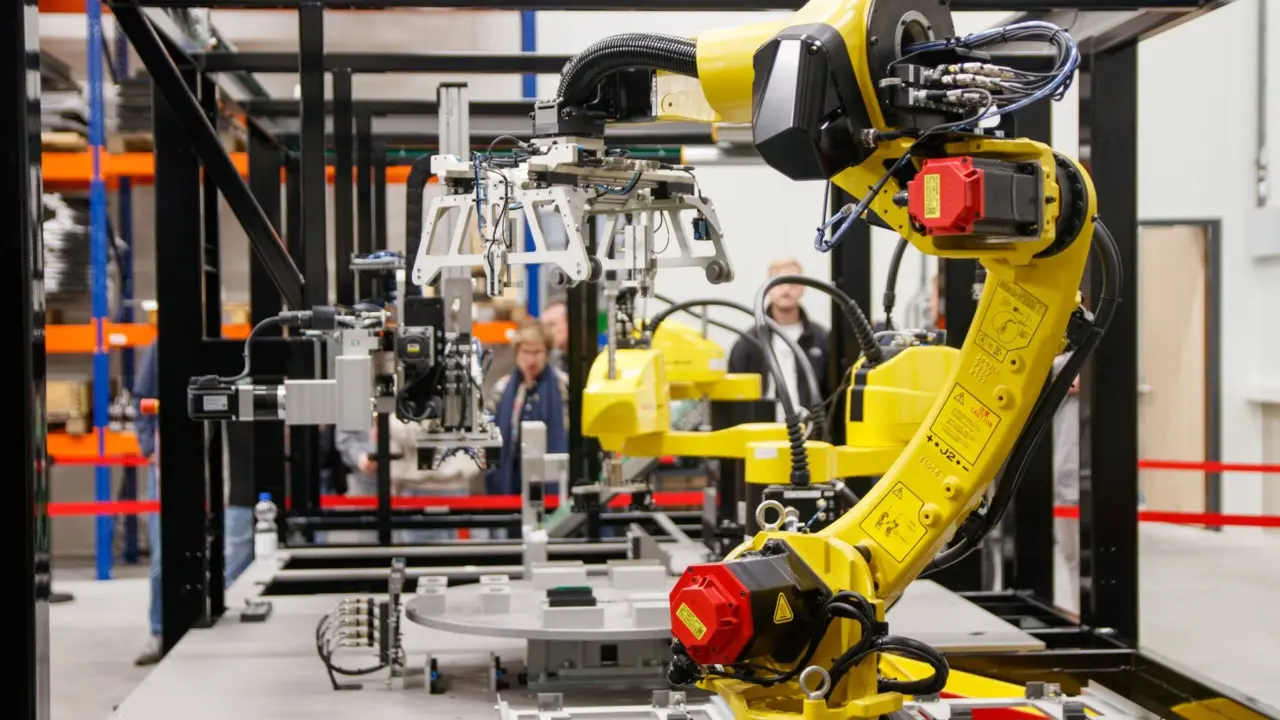
In robots, the natural fit is perception. Robots can use machine learning to identify objects in their environment, for example when picking and placing. Recognizing an item in a camera image is a labeling problem: each training picture can be tagged with the object it shows, and the model learns to assign that tag to new images. Robot vision systems, also known as machine vision, integrate sensors and cameras with learning algorithms for this kind of work.
Supervised learning also covers numeric prediction. In regression, the output variable is continuous and the model predicts numerical values. Choose a regression setup when the quantity the robot needs is a number rather than a category.
Best for: teams that can afford to label images or readings. Limit: the model is only as good as its labels, so unlabeled data cannot be used directly.
Unsupervised learning for unlabeled sensor data
Unsupervised learning deals with unlabeled data and is often used for clustering or association tasks. Clustering is a common unsupervised task whose goal is to group similar examples together.
Robot sensor streams arrive unlabeled, which makes them a natural match. Camera frames or lidar scans can be compared by their features, so that similar readings end up in the same group without anyone tagging them first. Feature extraction is the step that makes this possible: raw readings have to be turned into measurable features before a clustering method can compare them.

Best for: exploring recorded sensor data when no labels exist. Limit: the groups carry no names, so a person must still decide what each cluster means.
Reinforcement learning for trial-and-error control
Reinforcement learning is a process in which an agent learns to make decisions by receiving feedback, with the aim of maximizing cumulative rewards. The setup involves an agent, an environment, actions and rewards. The approach is often used in robotics, game playing and other applications where decision-making is important.
A documented example is a robot that learns to navigate a maze and receives a reward for reaching the goal quickly. In practice, reinforcement learning involves programming robots with task specifications and using rewards to guide learning.
Best for: control and navigation problems where success can be scored. Limit: someone has to define the task specification and the reward, and that definition shapes what the robot learns. For higher-level decisions about what the robot does next, see robot task planning.
Imitation learning from demonstrations
Imitation learning uses recorded demonstrations as its training input. Demonstrations are represented as state-action trajectories and work as input for the learning system. That makes it a reasonable choice when showing the task is easier than writing a reward for it.
Best for: manipulation skills a person can demonstrate. Limit: the robot only has the recorded demonstrations to learn from, so those demonstrations need to cover the situations it will meet.
Side-by-side comparison
| Learning type | Training data it needs | Typical robot task | Planning use |
|---|---|---|---|
| Supervised | Labeled datasets with known outputs | Vision-based recognition and numeric prediction | Pick when labeling effort is affordable |
| Unsupervised | Unlabeled data without predefined labels | Clustering or association of sensor readings | Pick for exploring data before any labeling |
| Reinforcement | Feedback from actions, expressed as rewards | Maze navigation and other decision-making tasks | Pick when a reward can be specified |
| Imitation | State-action trajectories from demonstrations | Skills a person can show the robot | Pick when demonstrating is easier than rewarding |
The descriptions above draw on the overview from Wandelbots and the type definitions from Certometer. Use the table as a first filter, then check the training data for the option you shortlist.
Training data and the development workflow
Whatever the type, the training data is the practical bottleneck. Supervised models need labeled examples, unsupervised methods need representative raw readings, reinforcement learning needs a defined reward, and imitation learning needs recorded demonstrations. Because the data decides which types are open to you, check it first.
Robot vision systems show how the pieces connect. Sensors and cameras produce the raw signal, feature extraction turns that signal into measurable inputs, and the learning algorithm works on those inputs.

- Inventory the data. List which of labels, raw readings, demonstrations and rewards you can actually obtain.
- Match the type. Use the bullets above to shortlist the one or two types your data supports.
- Test the need. Compare the shortlist against a conventional program for the same task before committing to a learned model.
Robotics tasks that still work better without machine learning
Machine learning is not the default answer. It requires a significant initial investment, and deploying it adds a significant layer of complexity and requires ongoing maintenance and updates.
When a task is stable and a hand-written program already performs it reliably, those costs are hard to justify, and the conventional program is the simpler option to keep. Use machine learning when the variation in a task is what a fixed program cannot handle, such as recognizing objects that a robot must identify in its environment.
Expect results to be checked closely. Use of machine learning and AI in robotics and automation is still in its early stages, so treat any learned component as something to validate on your own robot and task. Some robotics problems have dedicated, established methods. Estimating where a robot is, for example, is the focus of robot localization algorithms, which are worth reviewing before assuming a learned model is needed.
Frequently asked questions
Is deep learning a fourth type of machine learning?
No. Deep learning is a category of machine learning that combines all three types: supervised, unsupervised and reinforcement learning.
Does reinforcement learning need a labeled dataset?
Not in the same way. It learns from feedback: an agent receives rewards for its actions in an environment, so a designer defines the reward rather than labeling each example.
Is machine learning in robotics a mature field?
One source describes its use in robotics and automation as still in its early stages. Plan for testing and maintenance rather than assuming a finished solution.