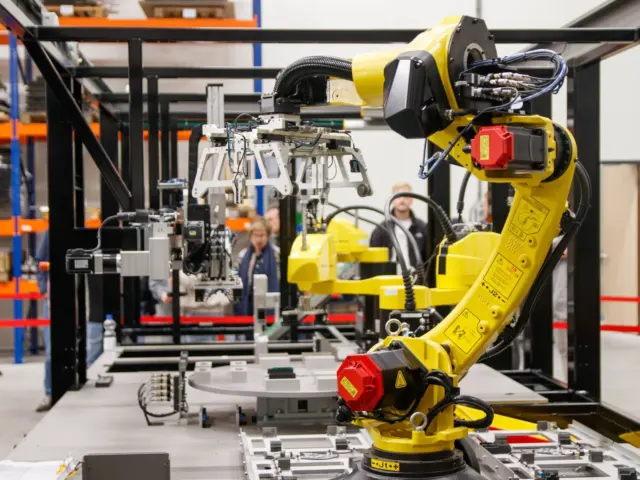

Asked to prepare a meal in a home kitchen, a robot first needs an ordered plan of steps. Robot task planning chooses those discrete steps and their order. Motion planning then works out how the arms and base physically carry out each step.
The two layers are easy to confuse, and most mistakes about this topic come from that. This guide works through the common misunderstandings and shows where the task layer hands off to motion. It also sits within the wider field of artificial intelligence in robotics.
What robot task planning decides
Robot task planning decides which actions a robot should take and in what order to reach a goal. MIT CSAIL gives a concrete case: to prepare a meal in a home kitchen, a robot must reason about high-level objectives, such as which ingredients are needed. That reasoning is the task layer. Its output is a sequence of named actions, not a set of joint trajectories.

A common misunderstanding is that a robot that moves well must therefore plan well. Smooth movement answers a different question. A robot with excellent motion control can still fetch the wrong item, or fetch the right items in an order that blocks its own next step. Task planning is the layer that prevents this by treating the job as a sequence of choices before anything moves.
The field also has a name for combining the layers. Task and motion planning, usually shortened to TAMP, integrates high-level task planning and low-level motion planning for long-horizon, dynamic tasks, according to a survey in IEEE/ASME Transactions on Mechatronics (2024). The point of the integration is that neither layer can be finished on its own, as the next section shows.
Task planning versus motion planning
Task planning and motion planning answer different questions at different levels, and each depends on the other. The table below sets the two side by side using the kitchen example, so you can see what each layer owns and what it must ask of the other.
| Criterion | Task planning | Motion planning | Planning use |
|---|---|---|---|
| Level of reasoning | High-level task actions | Low-level motions | Keep the two interfaces separate so each can be debugged on its own. |
| Kitchen question | Which ingredients are needed, and in what order to get them | How to open the refrigerator door and move several items out of the way before grasping | A single task step can expand into several motion steps. |
| Typical method | Logic-based task planning | Model-based trajectory optimization is one motion-level approach | Expect different tools on each side of the hand-off. |
| Dependence on the other layer | A chosen action may prove infeasible once motion constraints are considered | Needs the task layer to say which goal to reach next | Plan for feedback between layers, not a one-way pipeline. |
The kitchen example comes from MIT CSAIL’s task and motion planning research, and the interplay between logic-based task planning and model-based trajectory optimization is highlighted in the TAMP survey.
Misconception: a valid task plan is always executable
It is not. MIT CSAIL notes that low-level constraints affect the feasibility of a high-level action. An ingredient may sit at the back of a refrigerator, so the robot has to open the door and move several items aside before it can grasp anything. A task plan that simply says “retrieve the ingredient” hides that work, and whether the work is possible depends on geometry the task layer does not see.

Misconception: motion planning is just the detail work
Motion planning is not a cosmetic final step. Because it can overturn a task-level choice, it behaves more like a feasibility check on the plan. This is why researchers study both layers together rather than treating motion as an afterthought.
How symbolic planning represents a problem
Symbolic planning describes a problem in a formal language instead of raw geometry. A domain description states what actions exist, what each action requires and what it changes. A planner can then search over orderings of those actions. The TAMP survey reviews planning domain representations, including action description languages and temporal logic. Action languages describe the available steps, and temporal logic can express requirements that relate to ordering over time.
Symbolic does not mean disconnected from the physical world. The USC Robotic Research lab describes one of its speed-up techniques as instantiating symbolic conditions for pruning infeasible assignments. In other words, a symbolic condition can rule out an option before any expensive geometric check is run.

Three misunderstandings are worth clearing up here.
- Symbolic planning is not the whole job. It chooses steps and their order. Something else must still turn each step into movement.
- Symbols can act as filters. Symbolic conditions let a planner discard assignments that cannot work, which saves calls to the slower motion layer.
- There is no single notation. Action description languages and temporal logic are different ways of stating a domain, so the choice depends on what the task needs to express.
Hierarchical task planning
Hierarchical task planning organizes a job into levels, so a broad objective is broken into smaller steps and those steps are broken down again until they reach actions a robot can perform. The TAMP survey stresses hierarchical and distributed approaches as an important way to structure these algorithms. The kitchen again shows the idea: the objective of making a meal leads to the question of which ingredients are needed, which leads to retrieving each one, which finally leads to the motions of opening a door and grasping.

Hierarchy is not purely top-down, though. The survey describes a dynamic interplay between logic-based task planning and model-based trajectory optimization, so lower levels can send information back up. A task decomposition that ignores what the lower level reports will keep producing steps that cannot be carried out.
Several agents in one robot
Hierarchy can also cover who does what. The USC lab notes that multi-arm mobile manipulators can be represented as a combination of multiple robotic agents. Modelling one platform as several agents lets the planner assign tasks to each arm. It also means task assignment becomes part of the planning problem, which links directly to the feasibility checks described below.
Pitfalls at the hand-off
The costly part of task planning is rarely the task search itself. It is the checking that each assigned action can actually be done. USC reports that integrating motion planning with task-agent assignment is a computationally slow process, because infeasible assignments are detected only through expensive motion planning queries.
That finding shapes practical design in three ways.
- Filter before you query. The lab describes three speed-up techniques. They include pruning infeasible assignments with symbolic conditions and checking spatial constraints with conservative surrogates before the motion planner is called. If a cheap check can reject an option, do it first.
- Do not treat the first plan as final. Because motion constraints can invalidate a task step, a plan is a proposal that the lower layer may send back.
- Expect more agents to mean more checks. Modelling an arm as a separate agent adds assignment choices, and each choice may need a feasibility test.
These points suit anyone building a system where one task step can fail for geometric reasons. A purely symbolic planner is a poor fit for such a robot unless the feasibility checks are wired in.
Published examples on real robots
Published work shows task planning applied beyond toy domains. The USC lab reports that its developed method is useful for real-world operations that require complex interaction and coordination, and that its tests involved agents with many degrees of freedom. MIT CSAIL frames its task and motion planning algorithms around robots that must reason about high-level task actions and low-level motions simultaneously, using the home-kitchen meal as a motivating case.
Task plans also have to stay revisable once a robot is working. The USC lab describes contingency handling in which detection of a new potential contingency task leads to replanning. The discrete layer is therefore not a one-off calculation at the start of a job. It reruns when the situation changes.
Planning is one way to choose robot behaviour, and learned methods are another. How learning fits alongside planned behaviour is covered in machine learning in robotics.
Frequently asked questions
| Question | Answer |
|---|---|
| What does TAMP stand for? | Task and motion planning. It combines high-level task planning with low-level motion planning so that long-horizon, dynamic tasks account for both layers. |
| Can one robot count as several agents? | Yes. USC describes multi-arm mobile manipulators as a combination of multiple robotic agents, which lets the planner assign tasks to each one. |
| What triggers replanning during a job? | In the USC lab’s contingency handling, detecting a new potential contingency task leads to replanning. |
| Why is combining the layers slow? | Infeasible task-agent assignments are found only through expensive motion planning queries, so pruning with symbolic conditions and conservative surrogates helps. |