
A robot lifted and set down in an unfamiliar corridor can use visual place recognition: it compares its current camera image with stored images of known places and returns the closest matches as candidate locations.
That is the short version. It sits inside the wider field of robot vision systems, and anyone still asking how do robots see in the first place should start with the camera basics. The details below are organised around the assumptions that most often go wrong.
What place recognition actually answers
Visual place recognition is the task of determining whether a visual observation, typically an image or a sequence of images, corresponds to a previously visited place, according to a summary of the VPR literature. In its canonical form it maps a query image to one or more images in a reference database. An industry write-up puts it more simply: the place is recognised from its visual features alone, such as shapes and colours.
The word “same” needs care. The same summary, citing Garg et al. (2021), treats two observations as the same place when their fields of view overlap to a meaningful extent. A correct match is therefore a nearby, overlapping view, not a pixel-identical photograph. The table below sets common assumptions against what the literature supports.
| Common assumption | What is supported | Planning use |
|---|---|---|
| A match means the identical image | Two observations count as the same place when their fields of view overlap meaningfully | Judge matches by overlap with the query view, not by exact repetition of a stored frame |
| A place looks the same every time | Lighting, shadows, weather and seasons all change appearance, and recognition gets harder when appearance changes in the meantime | Test with queries taken under different conditions from the database images |
| One accuracy number tells the whole story | Common metrics include recall@N, mean average precision, AUC-PR, and speed and memory trade-offs | Report accuracy together with runtime and storage cost |
| A distinctive-looking descriptor removes confusion | Perceptual aliasing remains a core difficulty alongside appearance and viewpoint change | Add a verification or re-ranking step instead of trusting the top match |
The first, third and fourth rows follow the VPR summary, and the appearance-change row follows a research group’s place recognition page.
Image retrieval is the engine, not a side feature
A frequent misreading treats localization as something separate from search. In place recognition, the search is the localization step: the robot asks which stored image looks most like what it sees now, and the answer becomes a location hypothesis.
From query to candidate places
The pipeline described in the VPR summary begins with fast nearest-neighbour search in descriptor space, using KD-trees, product quantization or approximate nearest-neighbour search to pull candidate database images. Geometric verification, such as RANSAC on local features, then refines those candidates. A 2025 arXiv paper follows the same shape: a retrieval step, then a re-ranking mechanism that selects the most geographically plausible matches.

Retrieval can run at useful speed
Scale is not necessarily a blocker. Work reported on the research group page showed ConvNet-based place recognition with large maps reaching real-time speed, with speed-ups of two orders of magnitude and minimal accuracy degradation. The same page describes a 2021 RA-L study that adapted image retrieval techniques from place recognition to Bayesian state estimation for localization, with experiments on the Oxford RobotCar dataset. Retrieval therefore feeds a position estimate rather than replacing it.
NetVLAD and the global descriptor
A global descriptor summarises a whole image so that it can be compared with other images by distance in descriptor space. The VPR summary groups these descriptors into shallow-learned types, such as Bag-of-Visual-Words and VLAD, and deep-learned types, which include CNNs with NetVLAD, GeM, MixVPR and DINOv2-derived embeddings.
What NetVLAD is
NetVLAD is catalogued in a survey listing as a CNN architecture for weakly supervised place recognition, by Arandjelovic et al., from CVPR 2016. The practical meaning is that a convolutional network is trained so that its output descriptor for an image can be used directly for place retrieval. A robot computes the descriptor for its current frame and searches the database descriptors with the nearest-neighbour methods above.
Why learned descriptors help
Part of the appeal is robustness. Research reported on the same research page found that features from middle layers of convolutional networks are robust against appearance changes, which is why learned features outperform hand-built ones when lighting or season shifts.
- Bag of visual words: an older, shallow-learned approach. A survey listing includes the 2012 work on bags of binary words for fast place recognition in image sequences, so speed on sequences was an early strength.
- NetVLAD: a deep-learned alternative that suits appearance change better, at the cost of running a network for every query and database image.
- Newer embeddings: GeM, MixVPR and DINOv2-derived embeddings sit in the same deep-learned family, so NetVLAD is a baseline to compare against, not the only choice.
Why similar places confuse a matcher
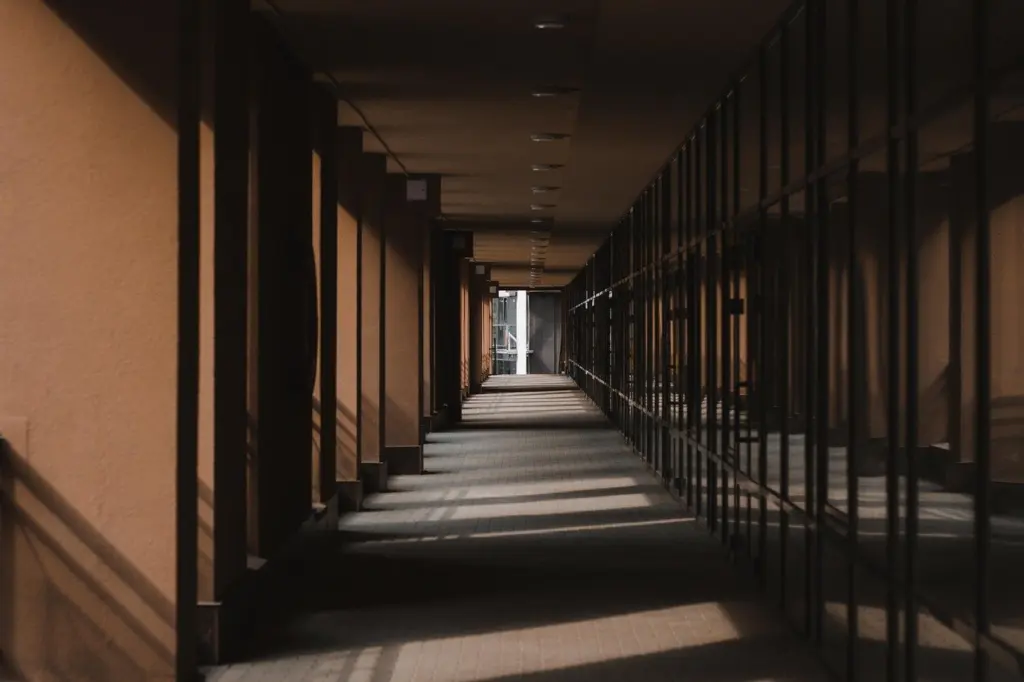
Perceptual aliasing means that different places produce similar images. The 2025 arXiv abstract states that traditional retrieval-based methods for geo-localization struggle with scalability and perceptual aliasing. Indoor robots meet this constantly, because offices and warehouses repeat the same corridors, doors and shelving.
Appearance change compounds the problem
Aliasing makes different places look alike, while appearance change makes the same place look different. The research group page lists lighting, with day versus night and early morning versus late afternoon as examples, along with shadows, weather and seasons. A system must therefore be tolerant of change without becoming so tolerant that it accepts look-alikes.
Repetitive structure
Repeated architecture is the clearest trigger for false matches. When every floor offers the same stairs and railings, global similarity alone cannot say which floor the robot is on.

The practical answer is not to trust the first retrieved image. Re-ranking and geometric verification exist to reject candidates that resemble the query but do not share its geometry.
Recovering from the kidnapped robot problem
In the kidnapped robot problem, a robot must work out where it is without a reliable prior estimate of its position. A 2025 arXiv paper describes planet-scale single-image geo-localization as “essentially an advanced or extreme version of the kidnapped robot problem”. Place recognition suits this case because it needs only the current image and a stored database, not a starting pose.
Recovery usually runs as a sequence:
- First, describe the view. Compute a global descriptor for the current camera image.
- Second, retrieve candidates. Search the database descriptors for the nearest neighbours.
- Third, verify. Re-rank candidates and apply geometric verification such as RANSAC on local features to reject look-alikes.
- Finally, fold the match into the state estimate. A retrieved place becomes a hypothesis for a Bayesian localization filter, as in the 2021 work on the research group page.
The same recognition capability supports loop closure in SLAM and long-term navigation, as a survey abstract notes. The difference is the trigger: loop closure checks whether a robot has returned somewhere it already mapped, while kidnapped recovery starts with no position at all. The sibling guide on loop closure slam covers the mapping side.
A newer hybrid approach in the arXiv preprint combines vision-language models with retrieval-based visual place recognition. It shows that retrieval remains the backbone even when language models are added on top.
Measuring accuracy and choosing benchmarks
Accuracy is judged by whether retrieved images depict the same place, using the overlap definition above. Recall@N asks whether a correct place appears among the top N retrieved candidates. Mean average precision and AUC-PR measure ranking quality, and the VPR summary adds speed and memory trade-offs as part of the evaluation.
For datasets, the same summary lists Oxford RobotCar, Pitts30k/250k, Tokyo 24/7, Mapillary SLS and Nordland among outdoor benchmarks. Pitts30k and Tokyo 24/7 are the usual starting points for comparing descriptors such as NetVLAD. Because these collections are outdoor, an indoor robot should treat benchmark scores as a guide to relative ranking and still validate on images from its own building, under its own lighting.
Frequently asked questions
| Question | Answer |
|---|---|
| Does indoor localization with place recognition need markers or beacons? | Not necessarily. An industry write-up describes an indoor localization solution based solely on images using VPR algorithms, without markers or beacons. |
| Are Pitts30k and Tokyo 24/7 indoor datasets? | No. They are listed among outdoor benchmarks, so indoor deployments should add their own test images. |
| Can retrieval over a large map run in real time? | Reported ConvNet-based work reached real-time speed on large maps, with speed-ups of two orders of magnitude and minimal accuracy degradation. |
| What do vision-language models add to place recognition? | A 2025 preprint combines them with retrieval-based VPR, using a retrieval step followed by re-ranking of the most geographically plausible matches. |