
What is loop closure in SLAM? It is the step where a robot recognizes a place it has already visited, verifies that match, and then optimizes its map so accumulated drift is corrected. The order is detect, verify, optimize.
Picture a robot driving a full circuit of an office floor. Its odometry says it is slightly off the start point, but the camera sees the same doorway it saw at the beginning. Loop closure turns that recognition into a correction, provided the match is real.
This guide sits within our wider coverage of indoor autonomous robots and concentrates on the loop closure sequence rather than SLAM as a whole.
What loop closure actually does
Loop closure is the ability of a robot to recognize that it has returned to a previously visited location, according to Slamtec. A successful closure greatly reduces cumulative errors, which improves navigation and obstacle avoidance. A recent arXiv paper on loop closure for visual SLAM calls it crucial for the accuracy and consistency of the map, because it recognizes previously visited locations and refines the map from them.
The need arises because local odometry is useful for short-term motion estimation but drifts over distance and time. Monocular visual systems also accumulate scale inconsistency. Without a way to tie the present to the past, small errors compound into a map that no longer closes on itself.
Several common beliefs about loop closure are only partly right. The table contrasts them with what the evidence supports.
| Common belief | What holds up | Planning use |
|---|---|---|
| Loop closure is just a map-drawing step | It starts as recognition of a previously visited location and ends with map refinement. | Treat detection and correction as separate stages that can each fail. |
| A visual match means a loop | A threshold decides whether a loop has occurred, and geometric verification follows. | Never feed raw similarity scores straight into the map. |
| Missing a loop is the worst outcome | A false loop closure is more harmful than a missed one. | Tune detection to be conservative. |
| Loop closure fixes drift continuously | Odometry drifts steadily, and the correction arrives only when a loop is found. | Expect corrections in jumps, not a smooth stream. |
The first two rows draw on the arXiv loop closure paper, and the last two on the Fictionlab loop closure glossary.
Detection: how a robot knows it has been here before
A robot recognizes a previous location by comparing what it senses now with a stored record of earlier places. This is place recognition, and it produces candidate matches rather than final answers. Candidates then pass to a verification step before they affect the map.
Bag of words place recognition
Bag of words place recognition quantizes local image features, such as ORB or SIFT, into visual words. A camera frame then becomes a collection of words that can be compared quickly with every earlier frame, which makes retrieval fast enough to run during mapping. The arXiv paper notes that loop detection in systems such as DPV-SLAM commonly relies on bag-of-visual-words approaches such as DBoW2.
The speed comes at a price. Bag-of-words loop detection is vulnerable to illumination and viewpoint changes, which frequently produce false matches or missed detections. Mobile robots face exactly these conditions: lighting shifts, dynamic occlusions and substantial viewpoint variation. A hallway photographed at dusk from a different angle may not share many words with the same hallway at noon.
Learning-based alternatives
Learning-based place recognition improves robustness across diverse viewpoints and lighting conditions, as the same paper describes. It suits robots that revisit places under very different conditions, such as a building mapped in daylight and used at night. Bag of words remains a lightweight choice where conditions stay close to those seen during mapping.

Verification and false loop closures
Detection proposes and verification disposes. In the pipeline described by the arXiv paper, a registration step uses a threshold to decide whether a loop closure has occurred and then performs geometric verification. The threshold can adapt: by default the median of five initial candidate similarity scores becomes the current threshold, so the cutoff follows the environment rather than a fixed constant.
Why false positives hurt
A false loop closure tells the optimizer that two different places are the same one. The optimizer obeys, and the map is bent to satisfy a constraint that is not true. Slamtec warns that a failed loop closure may corrupt the entire map, while the Fictionlab glossary states plainly that a false closure is more harmful than a missed one. A missed loop merely leaves drift in place, and a later pass over the same area can still catch it.
Where aliasing comes from
Perceptual aliasing is the usual cause of false positives. Long straight walls, identical corridors, repetitive crop rows and feature-poor terrain all look alike from different positions. Warehouses with repeated racks and bins are a good indoor example of that risk.
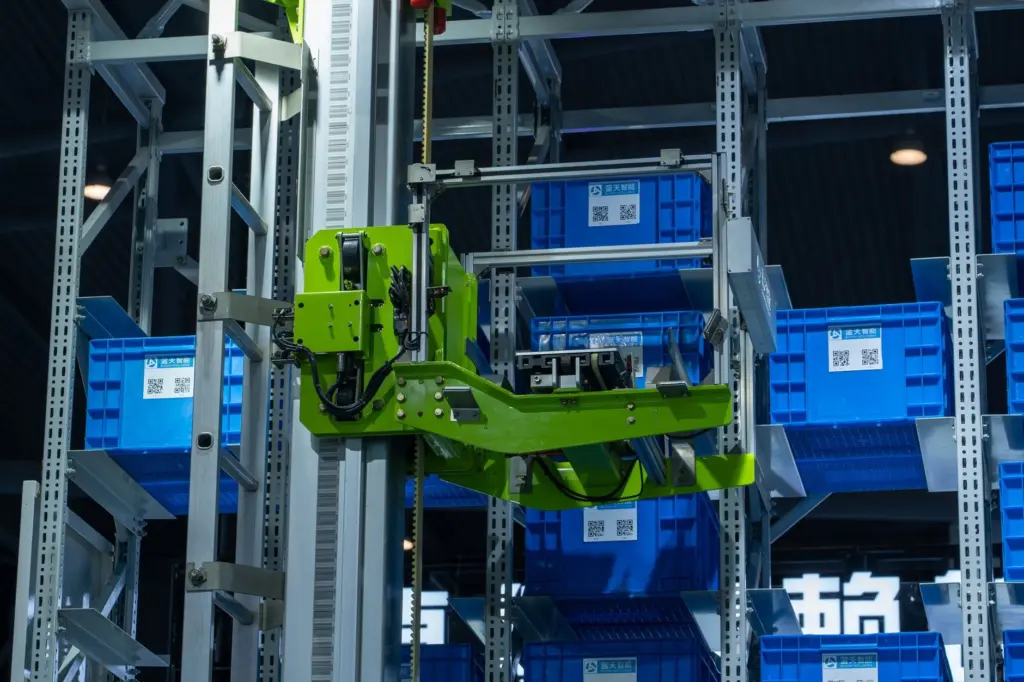
The practical rule is to favor caution. One loop closure note puts it directly: it is better to miss a real closure than to add a fake one. Geometric verification and a conservative threshold exist to enforce that preference.
Optimization: how drift gets corrected
Once a loop is verified, the system adds an edge to the pose graph, as the same note describes. Nodes in the graph are robot poses, and edges are constraints such as the relative motion between consecutive poses. The loop closure edge says that a late pose and an early pose are in nearly the same place.

Pose graph optimization then looks for the set of poses that best satisfies all constraints together. The Fictionlab glossary describes this as minimizing residuals weighted by an information matrix, so more trusted constraints pull harder. The arXiv paper describes the outcome as a final consistent map generated by pose graph optimization.

What changes for the rest of the robot
Because the correction is applied when a loop is accepted, the position estimate in the map frame can change discontinuously at that moment. Short-term motion estimates are better taken from local odometry, which is useful over short horizons even though it drifts over distance and time. A closed loop therefore improves the global map without making local odometry any less useful.
The correction also assumes the robot knows roughly where it is. A robot that has been moved or has lost its position entirely faces the kidnapped robot problem, which is a different task from fixing drift during a normal run.
Choosing settings and tools
Pose-graph SLAM systems such as slam_toolbox use the formulation above, according to the Fictionlab glossary. For these systems, the main tuning decision is how far to search for loop candidates. A larger search distance may find more candidates, but it raises computation cost and invites ambiguous matches. That trade-off favors a modest search distance in repetitive buildings and a wider one only where the layout offers distinctive landmarks.
- Repetitive interiors: keep detection conservative and rely on geometric verification, since identical corridors are the main source of false positives.
- Changing light: consider learning-based place recognition over plain bag of words when the same space is seen under very different lighting or viewpoints.
- Visual odometry front ends: loop closure corrects the drift that the front end accumulates, so understanding what is visual inertial odometry helps you judge how much correction to expect.
- Threshold behavior: an adaptive threshold that follows recent candidate scores adjusts to the environment better than a fixed number.
Frequently asked questions
| Question | Answer |
|---|---|
| Is DBoW2 the only way to detect loops? | No. DBoW2 is a widely used bag-of-visual-words approach, but learning-based place recognition is also used to improve robustness across viewpoints and lighting. |
| Which systems use pose graph formulations? | Pose-graph SLAM systems such as slam_toolbox estimate the pose configuration that best satisfies all constraints, including loop closure edges. |
| Why does a map sometimes jump at a loop closure? | The map frame can change discontinuously when a loop closure or global localization correction occurs, because the optimizer revises many poses at once. |
| Why is drift a bigger issue for monocular systems? | Monocular visual SLAM accumulates both drift and scale inconsistency over time, and loop closure is the process that mitigates these issues. |